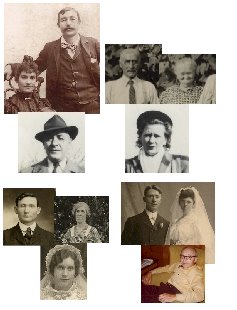
At left, Margaret Glynn Cogan (1838-1909). At right, Cogan Family in 1909; sons Thomas, John, Owen; daughters Mary, Julia, Margaret, Anna.
  Grandma Margaret (approx 1930) & her mother Hannah Byrne (click to enlarge) |
Irish immigrant Thomas Cogan Sr. & wife on the porch
of their home, built in 1881 (photo taken before 1909)

Early History
About fifteen miles from the sea, there were Sligo properties that Cogans lived in. Were these our Cogans?

The Cogan family occupied a property which in the early 18th century had belonged to the Phibbs family. The property at Rockbrook is listed as being part of the Martin estate in the OS name books in 1836. The property at Lisconny passed by inheritence to Lady Norbury whose mother had been a member of the Phibbs family. This property seems to have been occupied by Robert Baker in 1814. In June 1865 John Cogan offered for sale the estate at Flower Hill in the barony of Corran, formerly the property of the Irwin family. The particulars indicate that the estate had been purchased in the Landed Estates Court by James Cogan, brother of John. In 1866 Bernard Cogan was the petitioner in the sale of property belonging to Timothy O'Donel in the Landed Estates Court. Harloe Phibbs and James Cogan are jointly listed as the owners of over 2200 acres in county Sligo in 1876. At the same time Bernard Owen Cogan was the owner of over 1000 acres. In the 1870s Patrick Cogan was recorded as the owner of over 800 acres in county Sligo. At the time of Griffith's Valuation the representatives of Patrick Cogan were the lessors of property in the parish of Kilcolman, barony of Coolavin.
The likeliest civil parish is Drumcolumb, Sligo with four Cogan families.
Townland: Flower Hill
Civil Parish: Cloonoghil
Townland: Rockbrook
Civil Parish: Ballynakill
Townland: Lisconny
Civil Parish: Drumcolumb, Sligo
To America
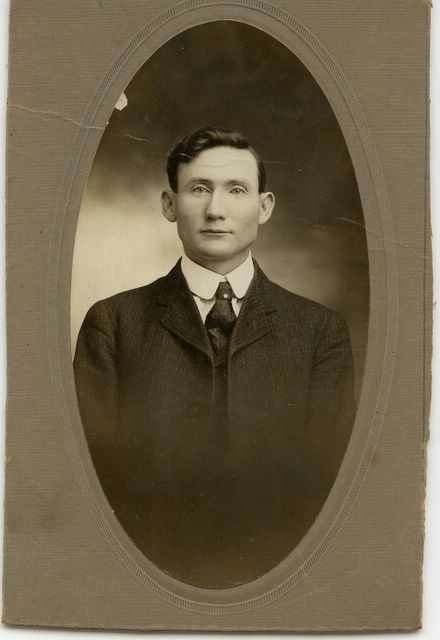
<- em="">Thomas P. Cogan (1875-1934), Grandma Margaret's father (late 1890s)
The Cogans made their way from blighted Ireland to America, and what made it possible to buy land was canal work, probably driving mules (which paid better than digging a canal, which was only thirty cents a day). They came to settle in what would later be called Glynnwood, a small crossroads with one church and one saloon in the southwestern portion of tiny Mouton Township within larger Auglaize County.
Moulton Township was organized Dec. 25, 1835. Dense wildnerness excpet for fifteen acres along the rivers in sections 25 and 26, cleared by Chief Peter Cornstalk's tribe of Indians. (The famous Bluejacket resided with Cornstalk's tribe for awhile, where what was in 1979 John Schelenker's brick residence. Cornstalk died in 1845.) The Eastern half of the township was formerly a Shawnee Indian Reservation.

“...Right up to our doorsill reaches the huge, somber and vaulted forest. There are no openings to break up the overshadowy wolf-haunted woodland...The sunlight cannot get through the arches of the murmuring leaves. Through the grayish shadow and down the pathways in the forest men walk, continually in a kind of midday gloom...” - Livvat Boke, memoirs from 1834 after her emigration from Germany to Mercer County
History From Mark C.
(Note: The following was given to me by Mark Connaughton - I'm not sure who wrote it):
"Our Cogan Family ancestors came to America, the land of Opportunity, in the years 1847 and 1848. They came, as so many of the Irish died, because of the Potato Famine of 1845 in Ireland. They didn’t have much money and came on the ships as steerage passengers, meaning; they lived and slept in the hold of the ship. They couldn’t read or write the English language.
 | The Cogans came from County Sligo, Ireland, which is in the north western section of what is now Free Irish State. There were three brothers and their sister [Bridget Catherine according to Bill Connaughton's documentation] that came to the United States. There may have been more children that didn’t come over. I have reason to believe they didn’t all come at the same time. The brothers; John, Thomas, Patrick* and their sister were the children of John and Mary Sheridan Cogan. John Cogan and Mary Sheridan stayed in Ireland; we do not know if they survived the Famine. According to a published account in “History of Western Ohio and Auglaize Co.” by C.W. Williamson, Thomas came with an older brother. Didn’t give his name, but John was the oldest. Thomas was listed on the 1850 census as living in a hotel in St. Mary’s. I am fairly sure they came in through New York. In 1850, Patrick appears on the New York Census as living in Syracuse. The three brothers worked their way over to Ohio and to Auglaize County in the early 1850s. They bought land with the money they had saved from working on the canals. They had to clear the land so they could farm it. It was so thick and wild back then that Thomas had to mark the bark of trees when he went to St. Mary's so that he could find his way back home. According to the 1900 census, Patrick Cogan (b. March 1820; son of John Cogan & Mary Sheridan) immigrated in 1840 and married Sarah Monahan sometime after 1852, the year she immigrated from Ireland. Their first child, John, was born in 1855. |
They bought land in Moulton Township, some of which was called Canal Land, even though the canal didn’t pass even close by. The reason it was called Canal Land was because the U.S. government owned the land to any purchaser. The money from the sale of these lands could only be used by construction of Ohio Canals. One of the larger buyers of these lands was the State of Arkansas. That is why some of the original deeds show Arkansas.
The Irish began to locate about five miles north east of St. Marys. As the Irish were Catholic, they needed to have a church. In 1857, they heard Mass said in the homes of Thomas and John Cogan and Mrs. Bridget O'Boyle. Then in 1860, the people built a frame church and in 1884 a brick church was built. The frame church stood where the cemetery is today."
* - Patrick Cogan's son John "drowned on 5/16/1895 in the Chicabeuqul river near Demopolis, Alabama. Mr. Cogan was in Alabama for eight years and was foreman of a logging camp near where he drowned."


Glynnwood & Moulton Twnship in 1898
(click to enlarge):

The baptismal register of St. Patrick's Church, on its first page, records these names: Cogan, Patrick and Sarah Monahan, parents of Sarah Bridget Cogan, the first child baptized in Glynnwood in 1861. The little community where the Irish settled was first called Six Mile. The name was changed to Glynnwood, naming it after John Glynn (Margaret's brother). The village was laid out in March, 1876. There isn't much left of Glynnwood today except St. Patrick's Church, the cemetery and four houses.

This Irish settlement was made up of the Clogans, Burks, Byrnes, Kenefecks, Kellys, Glynns, Connaughtons and others. Here is a poem written of the Cogan homestead (btwn 1909 & 1914? - after Margaret's death but before Thomas's?).

From Walsh's Biographical Sketches as printed in "History of Western Ohio and Auglaize County":
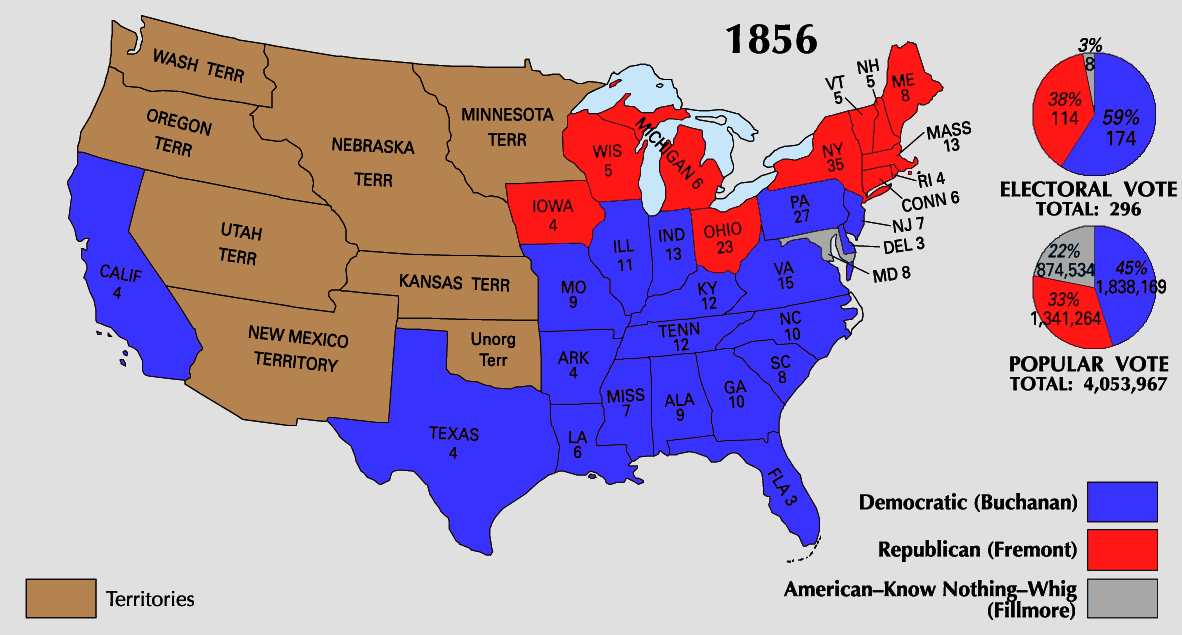
In 1847, our subject, in company with an elder brother, sought to better his condition by crossing the ocean to America, and after reaching this country the former was engaged for some time in driving teams on the Delaware and Hudson canals. This he continued for about six months, and afterward for about a year was engaged in repairing the canal. This was his first start in business for himself. Although his educational advantages had been limited in youth, he possessed a naturally bright mind and was quick to pick up all new methods and ideas.A 25-year old voting in his first election, Thomas faced a choice between the Democrat James Buchanan and the Republican John Fremont, who won Ohio but lost the election. Fremont was the first major presidential candidate to oppose slavery. Auglaize County as a county leaned heavily Democratic during the 1850s and this continued right up through 1900 when the Democrat, William Jennings Bryan, handily defeated William McKinley even though McKinley took Ohio.
In 1850, he emigrated to Ohio, and with the money he had saved he bought eighty acres of canal land in Moulton township, where he now resides. [In the 1979 "Hisory of Auglaize Co.", Patrick Cogan says that his great-grandfather paid $1.25 per acre, which would make $100. In today's money that's about $2,100. Digging canals earned thirty-one cents a day plus room & board, or about $75 a year.] This land was then wild and uncultivated, and infested with wild animals, but Mr. Cogan went actively to work to improve and cultivate his property. To the original tract he added from time to time, and in after years became the owner of two hundred and sixteen acres, all well improved and well cultivated. In 1891, oil was discovered on Mr. Cogan's farm, and there are now five oil wells and a gas well on the farm. These wells have yielded him a large income up to date, and are still in operation. [The wells yielded at least through Thomas Cogan's death in 1914, to which his large monument at St. Thomas Cemetery testifies. By the time of the Great Depression, however, his son had fallen on hard times and had to ask for money from relatives. By the 1980s the farm house was abandoned, stripped by vandals, and eventually torn down.]
In 1866, Mr. Cogan was wedded to Miss Margaret Glynn, a native of Ireland and the daughter of Owen Glynn, who was also a native of the Emerald Isle. After marriage Mr. Cogan and wife settled on their present farm, in Moulton township, and here their seven children were born: John F., May E., Owen P., Anna B., Thomas P.,Maggie T., and Julia A. Being deprived of good educational advantages in his own youth, Mr. Cogan greatly desired that his children should be well educated and has given them every opportunity. His eldest son followed teaching for a few years and is now an ordained priest in the Catholic church.
Mr. Cogan and wife have been members of the Catholic church nearly all their lives, and are active in their support of the same. In his political views, our subject inclines towards the Democratic party, but usually votes for the best man, irrespective of party. His first Presidential vote as cast for James Buchanan.
Perhaps they leaned towards isolationism, the Great War seems to have been the dividing line. Before the war Democrats won most Auglaize elections but after the war Republicans did. In 1916, the Woodrow Wilson (D); in 1920 the Republican (Harding) won Auglaize. In 1924, Calvin Coolidge (R) won large and in 1928, Herbert Hoover (R) was strongly supported. In 1932 FDR won and again in 1936. But beginning in 1940 and extending to every presidential election for the next 64 years, the Republican candidate won, with the single exception of Goldwater in 64.

(Via web correspondence with a G. Cogan):
"Exactly what brought the Cogan family to Sligo and by what route they took we do not know. Some say they arrived up the west coast as wool merchants. This I think unlikely due to the vast wealth available for the purchase and leasing of property. The earliest Cogan person known to be in the locality was Patrick Cogan. He and Owen Kilcullen, both of Taunaghnaeli, rented lands of Tarronaghirpy, commonly known as Owinbee to James Betty of Ballyfarnan, for fourteen years, at an annual rent of three pounds per annum, from the first day of May 1766. The only connection that can be made between this man and our family is that Patrick Cogan was the only Cogan to lease or buy lands in the lands in Sligo, Roscommon or Leitrem in the 1700's according to the "Register of Deeds" in Dublin where all transactions of that nature were stored."
"In 1847 - John Moffett of Merville, set the lands of Tonafortes to two brothers, Farrell and John COGAN. Farrell emigrated to America. They were kinsmen of Bernard O. COGAN of Lisconny House, for many years Sub-Sheriff and Sheriff in 1852. John fell on hard times and went into arrears with rent. Moffett sued COGAN...but failed in his efforts to have the debt discharged...he was obliged to take action. A warrant was obtained for COGAN'S arrest. COGAN managed to escape. Source: McTeran, M. C. (1998) 'In Sligo Long Ago Aspects of the Town and County Over 750 Years' Sligo: Avena Publications"
Grandma's Sister Rita:
 Margaret Glynn's (1838-1909) Brother?
An obituary says that Margaret Glynn's brother was for whom the town of Glynnwood was named. That was apparently John Glynn. He would've been the first of his family to arrive in America from the Townland of Tiaquin, Athenry, County Galway and his sister Margaret immediately afterward, in 1851. Mark C. says, "I think that she landed either at Prince Edward Island or Quebec. That was the cheapest and shortest passage from the West Coast of Ireland. John Glynn's other brothers also arrived later and moved on to Illinois. A brother, Peter, stayed in Ireland."
An 1880 History of Auglaize County says that:
"John Glynn was born in County Galway, Ireland on 8/15/1820, emigrated 8/28/1851 & settled in Columbus where he stayed until 5/15/1857, when he settled on a farm in Auglaize. Town was named for him by Samuel Craig."But according to familysearch.org, John Glynn was born 8/15/1827 and married Bridget Ruane on 3/27/1853 in Columbus, Ohio. (Their son Peter was born in Worthington, Ohio in 1856.)
If they Margaret & John were brother & sister, the birth of Anna Bern or Brennan, said to be both Margaret's & John's mother, was abt 1805. (According to familysearch.org.)
As for how Glynnwood got it's name? From the Wapa historical society:
"As the story goes, during the building of the railroad, a small boy 'with a broad Irish grin' worked fetching water for the laborers. The men took a liking to John Glynn's son, Henry, and began to tease that they would name the railroad stop after him. When the railroad built a depot here and had to decide on a name, Glynnwood was born."
Henry Glynn at left

An Economic History of the Cogan Homestead
The arrival of the railroads in the 1850s & 1860s ended the economic boon of canal work. But Thomas Cogan had arrived during the peak of the canal employment, and in just a few short years was able to buy land. A canal worker earned $75 a year, plus room & board, and if Thomas had saved most of his money he'd have the $100 he needed to buy 80 acres in Glynnwood.
He cleared the land, extremely hard work, and then added to his land holdings, eventually doubling and almost tripling the original eighty acres.
By 1881 he was well-off enough to build the large Cogan house.
In 1884, in nearby Findlay, large natural gas deposits were found: "The next year, Benjamin C. Faurot of Lima was one of hundreds of businessmen who visited Findlay to see the seemingly unlimited supply of natural gas burning day and night. Faurot decided to drill in Lima – for gas or water. Faurot’s first oil, found along the Ottawa River on May 19, 1885, was more accidental discovery than deliberate scientific experiment."
By 1886, Lima became the largest oil producing town in the world. Oil drilling fever hit northwest Ohio and “boom towns” sprang up over night.

In 1891 oil was discovered on Thomas Cogan's land and a large income resulted. Within Moulton Township, the luck of the Irish applied; it appears the thickness of the Trenton limestone beneath a given property determined whether you had oil or saltwater.

The dot under the 'G' & 'L' of 'Auglaize County' indicates
approx. location of Thomas Cogan homestead
"The Lima-Indiana oil and gas trend, which was extensively developed in the late 1800s and early 1900s, extends in a broad curve for 185 miles from Toledo, Ohio, southwestward to Indianapolis, Indiana. The principal reservoir rock throughout this trend is the Ordovician Trenton / Black River Limestone."
If it were not for John D. Rockefeller it would've been for nought. The Lima oil was called skunk oil since it smelled terrible and thus wouldn't be popular for use in homes. It also had a high sulphur content that damaged machinery. In short, it was unusable and the board of Standard Oil told Rockefeller to forget about Ohio oil and move on. There was so much resistance that Rockefeller told them he was going to put $3 million ($46 million in today's dollars) of his own money towards it. This huge personal bet convinced the board. Rockefeller hired a German chemist to attempt to find a way to make the oil saleable and after two years the chemist succeeded.
According to a newspaper interview with Bob Burke, "There was a lot of oil in the area. In the late 1800s there was very little farming done around Glynnwood. They had gasoline engines pumping and sucker rods all over the fields. You were independently wealthy; if you had an oil well, you had a gold mine." Burke explains further that when Standard Oil purchased the Pat Sweeney property on Doering Road (west of Moulton-Fort Amanda Road), the company's drilling "drained the oil" from the neighbors' properties.
By 1901, the excitement over Ohio oil slowed with the news of a Beaumont, Texas, gusher producing 100,000 barrels a day. For Lima - and perhaps Thomas Cogan - "production peaked in 1904, and then dropped off rapidly. By 1910, the field was regarded as virtually played out."
"The oil was gone, and with it the profits and jobs. Even worse, the land could not be farmed because of the drilling equipment still installed in the ground. After the equipment was eventually removed and the land allowed to sit fallow for some time, it regained its fertility, and the area around Glynnwood once again became a farming community." (from "A History of St. Patrick Catholic Church & Glynnwood")
By the time of the Great Depression, his son Thomas asked for help from relatives in bigger cities.
And by the 1980s, the farm-house was vacant, the furnishings stripped by vandals and was soon torn down. The house Thomas Cogan built survived about a century.

<--one a="" and="" as="" back="" br="" church="" cogan="" current="" days="" door="" downstairs="" granary="" hotel="" in="" it="" lived="" next="" of="" old="" patrick="" relatives="" right="" s="" said="" saloon="" served="" st.="" that="" the="" to="" upstairs="">
Thomas Cogan, Devout Catholic & Tireless Walker
(My great-great grandfather)
The following was obtained from an the local historical society in Auglaize County and concerns my great-great grandfather who died in 1914 and who, after first emigrating, had no nearby church:
"The Rev. James P. Ward, who preached the funeral sermon, said: 'Mr. Cogan was known to walk from Glynnwood to Piqua to be present at the divine Sacrifice of the Mass. It was his earnest zeal that prompted him to have a church close at hand, and he with others of the same sturdy faith united their efforts and established a pastorate at Glynnwood.'"Even as the crow flies the distance between Glynnwood and Piqua must be thirty miles - at least a seven to nine hours on foot.
But I would walk 500 milesFr. James Byrnes said that one of his earliest memories was sitting on the lap of Cogan as Thomas was smoking his pipe. He said that Cogan was sent on a ship from Ireland to Quebec at the age of 12, and when they needed someone to pump water out of the ship and he did so. On the boat from Quebec to America, Cogan heard two men planning a robbery and one of them belatedly noticed Cogan and asked whether they should kill him, assuming the youngster had overheard. The other said that they shouldn't because he was probably sleeping. Many years later Thomas Cogan was asked if he wanted to go on a trip to Ireland but he refused; the memories too bittersweet.
And I would walk 500 more
Just to be the man who walked a thousand miles
To fall down at your door --lyrics to Proclaimers song
The Priest who celebrated Mass at Thomas Cogan's home
C.W. Williamson writes of Catholics in Auglaize County: "Prejudice was strong and it required an effort that the present generation can hardly appreciate to keep the light of faith buring in the hearts of people."
 | From History of Auglaize County (submitted by Thomas Byrne & John Burke):On March 17, 1857, Apostolic Missionary Father Patrick Henneberry (born in Ireland in 1830) came from Lima to offer Mass which was celebrated in the homes of Thomas and John Cogan, Mrs. Bridget O'Boyle and Jerome McFarland. When Father Henneberry was absent giving Missions, Fathers Matthias Kreusch, Andrew Kunkler and Andrew Herbstritt offered Mass for the "Settlers" as they were called.One legend has it that Thomas Cogan was among the builders, and so when it came time to name the church the twelve families put their names in a hat and pulled "Thomas". |
Obituary of his son, Thomas Patrick Cogan, Grandma's Brother:
"Thomas P. Cogan, 88, of rural Wapakoneta, died at 10:31 a.m. Sunday, Nov. 16, 2003, at his residence.
He was born Oct. 19, 1915, in Glynnwood, the son of Thomas Peter (1875-1934) and Hannah (Byrne) Cogan (1881-1973). On August 9, 1941, he married Julia C. Berg, and she died Sept. 16, 1999. Survivors include two sons, Pat (Mary) Cogan of St. Marys and Jim (Marge) Cogan of Columbus; two daughters, Dottie (Bill) Shultz of Botkins and Mary (Charles) Brackman of Wapakoneta; 13 grandchildren and 10 great-grandchildren; and a sister, Margaret Connaughton of Hamilton. In addition to his parents, he was preceded in death by two sisters, infant Cecelia and Rita Cogan.
A farmer, Mr. Cogan was a member of St. Patrick Catholic Church in Glynn-wood. A Mass of Christian Burial will be held at 10:30 a.m. Wednesday at St. Patrick Catholic Church, Glynnwood, with the Rev. Oscar Seger and Mr. Cogan's cousin, the Rev. James Byrne, officiating. Burial will follow in St. Thomas Cemetery, Glynnwood."

Rt. Rev. Msgr. John F. Cogan


Rev. John Cogan on left; his brother Thomas Cogan on right (1909)
Before she was married, Grandma Margaret worked for St. Joseph Church in Hamilton (my dad's sister Joan was principal at the grade school there decades later) for her uncle Fr. John Cogan. Fr. Cogan, born on March 21, 1867 - about twenty years after his teenaged father emigrated from Ireland - entered Mount St. Mary's Seminary and was ordained 6/21/1901. Before that he went to college in Indiana at a school run by the Precious Blood fathers, probably Saint Joseph College in northwest Indiana though the school had begun in 1889. It was likely there that he learned to speak German - so fluently that parishioners at his German parish would say that he spoke better German than some of the congregants! From a history of St. Joseph's Church:
In July, 1929, Fathers George and John Mayerfoefer were transferred. In August, 1929, Rev. John F. Cogan became the tenth pastor of St. Joseph Church...Fr. Cogan's pastorate brought an end to the exclusive tradition of German pastors being in charge of St. Joseph Kirche. The Cogan years are not remembered nor celebrated because of building of buildings but rather for the keen business and spiritual leadership he exhibited in overcoming and eventually erasing the enormous debt which hung over the parish like a cloud of poisonous gas ready to choke the life from all caught in its wake. Fr. Cogan built fiscal structures which not only removed the burden of indebtedness in his day but remain even today as major revenue sources to support the operation of parish and school.
Within two months after Fr. Cogan began to rally parishioners, the country was hit with the stock market crash. The years following the event have been called the Great Depression. To have defaulted on the loans during those years would have been understood by all - all, that is, except Fr. Cogan.
First Communion with Fr. Cogan (large view)

Fr. Cogan's pastorate was more than debt reductions. For nineteen and a half years, Fr. Cogan was a prominent figure in the Deanery and throughout the city. He initiated and encouraged several new societies, groups and associations at St. Joseph. The parish was the focal point of the everyday life and activities of the parishioners. Numerous missions were conducted during Fr. Cogan's pastorate.The Butler County Historical Society describes him as saintly:
Following a lengthy period in the hospital, Fr. John Cogan died at the age of 81 on December 7, 1948. His body was returned to St. Joseph Church to lay in state from 4:00pm on Dec. 11, 1948 until his funeral at 10:30am the next morning. The parishioners came to the church throughout the night keeping a prayer vigil for the soul of their faithful shepherd. A solemn Requieum Mass was offered on Saturday, Dec. 12, 1948, in the presence of Archbishop McNicholas and with Rev. John P. Byrne and Rev. James O. Byrne (nephews of Msgr. Cogan), and Rev. Edward Connaughton and Rev. Charles Moore (native sons of the parish).
A sidelight on the dedication ceremonies is that the new church was described as a "German Catholic Church”, and the name in stone still on the front of the church arrests to that classification. It was many years later, in the early nineteen hundreds during the pastorate of Father Holthaus, that German was replaced by English in general usage in the church at the instigation of Archbishop Moeller. Even afterwards the church was known as a German church in distinction to St.Mary's, which was known more or less as an Irish church, although general use of the German language had almost disappeared. The typical American fusion of peoples from different lands had worked inexorably until in 1947 at the funeral of Msgr. Cogan, Archbishop McNicholas could pay tribute to that saintly man by commenting on what he had done to bring about such a wholesome disregard of national origins.


Margaret Connaughton Obituary
Margaret Mary CONNAUGHTON
(October 23, 1911 - December 22, 2006)
Connaughton, Margaret age 95 of Fairfield died Friday,December 22, 2006, at the Fairfield Pavilion She was born in Glynnwood, Oh, on October 23, 1911, the daughter of Thomas and Hannah (Byrne) Cogan. On August 19,1936 she married William Connaughton, and he proceeded her in death on December 9, 1977. She was a member of St. Ann church. For many years she was a member of Sacred Heart Catholic Church where she was very active in their Mission Commission. She was a very devoted mother to her six children. She is survived by her Sons, Thomas, William, James (Becky) Connaughton of Hamilton. Michael Connaughton of Cincinnati and Mark Connaughton of Fairfield; her daughter, Mary Alice (Mark) Smith of Fairfield, ten grandchildren and seventeen great grand children. Besides he husband, she was preceded in death by her parents; her brother, Thomas Cogan, and two sisters, Cecilia and Rita Cogan. The family would like to thank the Fairfield Pavilion for the wonderful care they gave our mother during the past 3 yrs.

Now Grandma Margaret's long life of ninety-five years has ended and the poignant part was remembering how hard it was to have six children far from her own family clan. She lived almost always as the outsider, an in-law, an Irish among the Germans back when there was a difference. She gave up her clan but for visits once or twice a year, like the nun who goes to cloister.
"She prayed the rosary when times were bad. She prayed the rosary when times were good." --Fr. Jim Byrnes eulogy at Grandma's funeralThe celebrant, Rev. Tharp, said that Grandma’s living monument is not made of stone or anything that can weather but was right here in church – her children and grandchildren and great-grandchildren. He mentioned how his favorite chalice began to show signs of wear and how he took it to a man who promised to fix it, and how that man tore it apart – only to eventually remake it with a double-plating that would make it last far longer than it did originally. A metaphor for how our bodies are broken down only to be re-made into glorious ones. "This earthly life is like the preface to a book. Not the whole story or even the first chapter. The preface!"
| ______________________________________________________ Cogan Descendants: Cogan references in Sligo literature here. More Cogan genealogy here. ______________________________________________________ |  Grandma Margaret wedding day |